HAWQ and Hadoop and Open Source and a Wacky Idea

I want to soften my criticism of Greenplum‘s announcement of HAWQ a little. This post by Merv Adrian convinced me that part of by blog here looked at the issue of whether HAWQ is Hadoop too simply. I could outline a long chain of logic that shows the difficulty in making a rule for what is Hadoop and what is not (simply: MapR is Hadoop and commercial… Hadapt is Hadoop and uses a non-standard file format… so what is the rule?). But it is not really important… and I did not help my readers by getting sucked into the debate. It is not important whether Greenplum is Hadoop or not… whether they have committers or not. They are surely in the game and when other companies start treating them as competitors by calling them out (here) it proves that this is so.

It is not important, really, whether they have 5 developers or 300 on “Hadoop”. They may have been over-zealous in marketing this… but they were trying to impress us all with their commitment to Hadoop… and they succeeded… we should not doubt that they are “all-in”.

This leaves my concern discussed here over the technical sense in deploying Greenplum on HDFS as HAWQ… or deploying Greenplum in native mode with the UAP Hadoop integration features which include all of the same functionality as HAWQ… and 2x-3X better performance.

It leaves my concern that their open source competition more-or-less matches them in performance when queries are run against non-proprietary, native Hadoop, data structures… and my concerns that the community will match their performance very soon in every respect.

It is worth highlighting the value of HAWQ’s very nearly complete support for the SQL standard against native Hadoop data structures. This differentiates them. Building out the SQL dialect is not a hard technical problem these days. I predict that there will be very nearly complete support for SQL in an open source offering in the next 18-24 months.

These technical issues leave me concerned with the viability of Greenplum in the market. But there are two ways to look at the EMC Pivotal Initiative: it could be a cloud play… in which case Greenplum will be an uncomfortable fit; or it could be an open source play… in which case, here comes the wacky idea, Greenplum could be open-sourced along side Cloud Foundry and then this whole issue on committers and Hadoopiness becomes moot. Greenplum is, after all, Postgres under the covers.

Aster Data for a price…

(Photo credit: Wikipedia)

If Greenplum HAWQ does not look promising (see my previous posts on HAWQ here and here) what are the prospects for Teradata Aster Data… which aspires to both replace and/or co-exist with Hadoop for a fee? Teradata+Hadoop maybe… but Teradata+Aster+Hadoop seems like one layer too many… as does Aster+Hadoop.

(OK, I removed the bad “HAWQing” pun in the title… no complaints from readers… it just seemed unfair… – Rob)

HAWQ Performance Marketing

My contacts from Strata read my post here and provided me with the following information:

  • The performance numbers quoted for Greenplum HAWQ versus HIVE and Impala used Greenplum tables implemented over HDFS. In other words, this data is unreadable from outside of the Greenplum database… unreadable by any other program in the Hadoop eco-system… a proprietary format. If the tests were re-run using the same open data structures used by HIVE and Impala you would find the performance of HAWQ to be closer to, or worse than, those Hadoop components.
  • The HAWQ performance numbers quoted represent a 2X-3X performance degradation over the same benchmark run on the native Greenplum RDBMS.

Again… this is from a credible source… but please consider this a rumor… and view this report, and the associated Greenplum marketing… with an appropriate measure of engineering skepticism.

Greenplum is a fantastic product… if I assume the report to be true then I do not understand why are they doing this… what use case is solved by a 300% performance degradation accessing proprietary data in HDFS? Remember, you could put Greenplum in the same cluster as Hadoop (UAP) and query everything HAWQ could query without the performance degradation. I just do not see the point? Could someone from GP comment and help my readers and myself here?

My 2 Cents: Greenplum 1Q2013

Unripe plums (Photo credit: Wikipedia)

Since my blogs tend to be in response to some stimulus they may not reflect a holistic view on any particular product. The “My 2 Cents” series will try to provide a broader view…

Please consider this as you read on…

Summary

From a technical perspective, Greenplum is my favorite data warehouse database. Built on the same architecture as Teradata (see here), the Greenplum team was able to extend the core of Postgres… first building out a shared-nothing architecture and then adding feature after feature… putting the heat on the other major players. Greenplum was the first row-based RDBMS to add full columnar support… and their data-loading capability is second-to-none.

Oddly they do not want to be in the data warehouse space. Their recent announcement (here) does not include any reference to data warehousing or business intelligence. The tweets from @Greenplum, the Greenplum website, and all things marketing are focussed on analytics and/or Hadoop. Even their page on data warehousing (here) has no articles on data warehousing. It is just not their target market. That is fine… the product is still a great EDW platform… but it is a worry.

Where They Win

The reason they target analytics is because they excel there. If your warehouse workload clogs because of big, complex, queries… Greenplum can win the day. Their data flow architecture, which keeps tuples moving from execution step to execution step without writing to spool provides them with the ability to beat the competition on analytics. They provide a very rich set of in-database analytics and some add-on capabilities to improve the productivity of your data scientist team.

Their data load architecture, which they call scatter-gather, is a big differentiator. If your problem is that you cannot get data loaded and reports out in your nightly batch window then the combination of scatter-gather and the ability to run big report queries is unbeatable.

Greenplum also has a unique solution for near-real-time. They marry Gemfire, an in-memory object-oriented database, with scatter-gather to move small batches of inserted data to Greenplum with a very small time delta. I do not believe this solution supports inserts or deletes as they have to be applied directly to the Greenplum database… but it is a nice capability for a certain class of problems.

Where They Lose

Greenplum, like Teradata, can be beat when the problem to be solved is narrow. In these cases, when the database supports a single application with a small number of queries or when it supports a narrowly focussed data mart, they are vulnerable to Netezza, Vertica, or even Exadata. It is also sometimes the case that a poorly designed POC can narrow the scope enough that Greenplum loses.

Greenplum can also lose when a full EDW is required. The basic architecture of the RDBMS is capable of supporting an EDW… but some of the operational features required… RASR, workload, incremental backup, etc. are not mature. This may well be the intentional result of their focus away from these features at analytics.

In the Market

Despite the worries Greenplum should be included in every POC. They will push Teradata hard in performance and in price/performance.

As noted here… I do not understand their market strategy. It seems that they are competing with themselves by offering Hadoop for analytics… but this cannot be a bad thing for customers even if it is an odd position in the market. The analytics market they favor is tough… relatively small (compared to the DW space)… emerging… there are several capable competitors… and the market is haunted by the same problem that killed the data mining market in the mid-1990’s… there are just not enough skilled data scientists (see here).

My Guess at the Future

I cannot guess at the future of Greenplum… They are being moved into a new business unit that could be spun into a new company that has a charter to build software for the cloud (see here). This is odd in several dimensions. First, as I noted here, the shared nothing architecture Greenplum is built on is not a perfect fit for the cloud. There are ways to get around this (maybe the topic for a future post?) but it will require development in a fundamentally new direction. Further, the new division seems to be a software-only venture. This makes the future of the EMC Greenplum Data Computing Appliance uncertain. I suppose that there will be announcements soon to clarify these questions… but the architectural disconnects make it likely that there will be some arm-waving for a while.

Next up… my 2 Cents on The Rest…

Will Hadoop Eat Greenplum and Netezza?

If I were the Register I would have titled this: Raging Stuffed Elephant To Devour Two Warehouse Vendors… I love the Register… if you do not read it have a look

This is a post is about the market implications of architecture…

Let us assume that Hadoop matures and finds a permanent place in the market. This is not certain with some folks expressing concern (here) and others boundless enthusiasm (here). So let’s assume… and consider where it might fit.

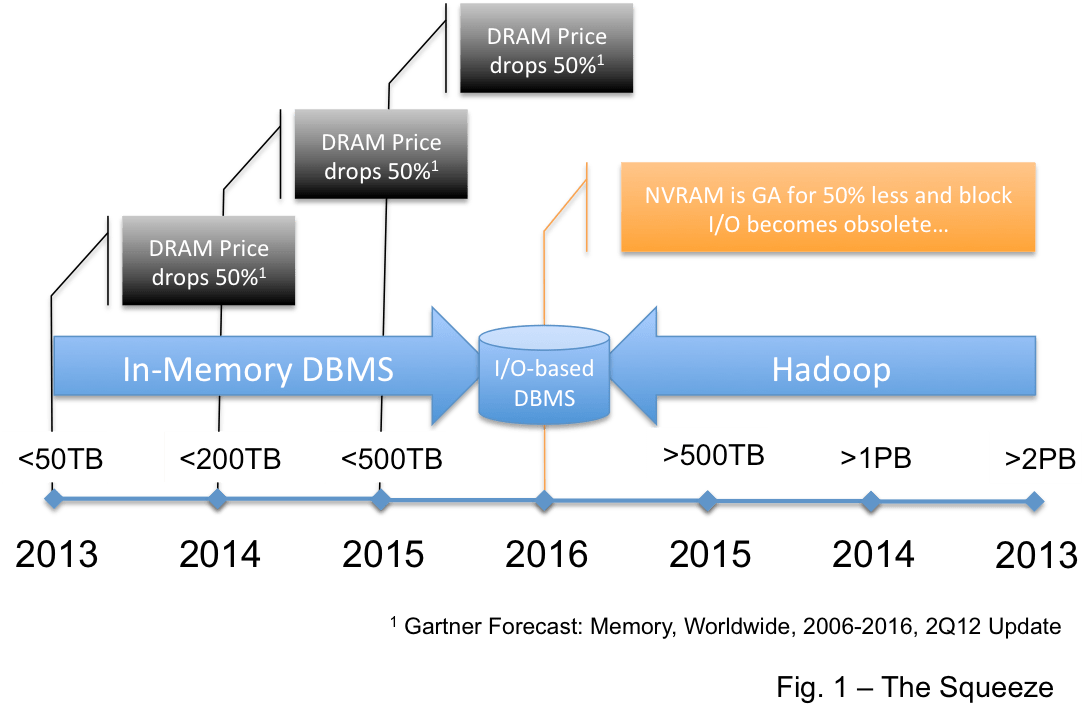
One place is in the data warehouse market… This view says Hadoop replaces the DBMS for data warehouses. But the very mature BI/DW market requires a high level of operational integrity and Hadoop is not there yet… it is advancing rapidly as an enterprise platform and I believe it will get there… but it will be 3-4 years. This is the thinking I provided here that leads me to draw the picture in Figure 1.

It is not that I believe that Hadoop will consume the data warehouse market but I believe that very large EDW’s… those over 1PB… and maybe over 500TB will be compelled by the economics of “free” to move big warehouses to Hadoop. So Hadoop will likely move down into the EDW space from the top.

Another option suggests that Big Data will be a platform unto itself. In this view Hadoop will sit beside the existing BI/DW platform and feed that platform the results of queries that derive structure from unstructured data… and/or that aggregate Big Data into consumable chunks. This is where Hadoop sits today.

In data warehouse terms this positions Hadoop as a very large independent analytic data mart. Figure 2 depicts this. Note that an analytics data mart, and a Hadoop cluster, require far less in the way of operational infrastructure… they share very similar technical requirements.

This leads me to the point of this post… if Hadoop becomes a very large analytic data mart then where will Greenplum and Netezza fit in 2-3 years? Both vendors are positioning themselves in the analytic space… Greenplum almost exclusively so. Both vendors offer integrated Hadoop products… Greenplum offers the Greenplum database and Hadoop in the same hardware cluster (see here for their latest announcement)… Netezza provides a Hadoop connector (here). But if you believe in Hadoop… as both vendors ardently do… where do their databases fit in the analytics space once Hadoop matures and fully supports SQL? In the next 3-4 years what will these RDBMSs offer in the big data analytics space that will be compelling enough to make the configuration in Figure 3 attractive?

I know that today Hadoop cannot do all that either Netezza or Greenplum can do. I understand that Netezza has two positions in the market… as an analytic appliance and as a data mart appliance… so it may survive in the mart space. But the overlap of technical requirements between Hadoop and an analytic data mart… combined with the enormous human investment in Hadoop R&D, both in the core and in the eco-system… make me wonder about where “Big Data” analytic relational databases will fit?

Note that this is not a criticism of the Greenplum RDBMS. Greenplum is a very fine product, one of the best EDW platforms around. I’ll have more to say about it when I provide my 2 Cents… But if Figure 2 describes the end state for analytics in 2-3 years then where is the place for the Figure 3 architecture? If Figure 3 is the end state then I do not see where the line will be drawn between the analytic workload that requires Greenplum and that that will run on Hadoop? I barely can see it now… and I cannot see it at all in the near future.

Both EMC Greenplum and IBM seem to strongly believe in Hadoop… they must see the overlap in functionality and feel the market momentum of Hadoop. They must see, better than most, that Hadoop wins this battle.

A Story of Hadoop Disillusionment…

(Photo credit: kerryj.com)

Here is a true story… fuzzed just a little to disguise the real-life characters…

Three years ago… a friend calls to say: “Our new CxO just informed us that we needed to install a 1000-node Hadoop cluster in the next two months. I said… cool, what is the use case? He says… don’t argue with me… just get 1000 nodes up and running in the next 60 days. I say: there is no floorspace or power for that large a system. He says: do it in the next 60 days!”

My friend then decommissioned several systems that were doing productive, but expendable work, and installed 1000 nodes of Hadoop. And it sat there with no business problem to solve.

Today there is a little work running on the cluster… adding far less value than the expendable work that was decommissioned. The CxO is gone… with a glowing resume that says that he deployed one of the World’s largest Hadoop clusters.

When the hype over a technology gets so amplified that the hypers start hyping about the level of the hype… Hype-squared… you know that disillusionment cannot be far behind.  Gartner is pretty spot on with their Hype Cycle (see here)… but Hadoop may survive, methinks.

Readers… any other good Hadoop hype stories to share?

Getting started with Hadoop… Enhance Your Data Warehouse Eco-system

Gartner thinks that the Big Data hype is going to die down a little for the lack of progress… (see here) Companies without web-scale, big, data are finding it hard to do anything commercially interesting… still CIO’s sense that Hadoop is going to become important. This post provides a suggestion that might help you to get started.

In most data warehouse eco-systems there is an area, a staging place, where data lands after it is extracted from the source and before it is transformed. Sometimes the staging area and the ETL process are continuous and data flows through the ETL hardware system without seeming to land… but it usually is written somewhere.

The fact is that often enterprises only move data to their data warehouse that will be consumed by a user query. Often users want to see only lightly aggregated data in which case aggregation is part of the ETL process… the raw detail is lost. A great example of this comes from the telecommunications space. Call details may be aggregated into a call record… and often call records are sufficient to support a telco’s business processes.

But sometimes the detail is important. In this case the staging area needs to become a raw data warehouse… a place where piles of data may be stored inexpensively for a time… possibly for a long time.

This is where Hadoop comes in. Hadoop uses inexpensive hardware and very inexpensive software. It can become your staging area and your raw data warehouse with little effort. In subsequent phases, you can build up a library of the jobs that need to look at raw data. You might even start to build up a series of transformations and aggregations that might eventually replace your ETL system.

This is what Sears Holdings is up to (see here).

As I suggested in an earlier post, the economics of Hadoop make it the likely repository for big data. Using Hadoop as the staging area for your data warehouse data might provide a low risk way to get started with Hadoop… with an ROI… preparing your staff for other Hadoop things to come…


A Look Back at 2012

There seems to be a sort of odd tradition for bloggers to look back at the past year as the New Year starts to unfold. Here is my review of my posts and some presents

(Photo credit: Wikipedia)

Top Post

Far and away the most viewed post was Exalytics vs. HANA What are they thinking? This simply notes that these two products are not really comparable sharing only the descriptor “in-memory”.

My Favorite Post

I liked this the best… ’nuff said: What is Big Data?

OK, here is my 2nd favorite: A Quick Five Minute Rule Update for In-memory Databases, but you probably need to read the prequel first: The Five Minute Rule and In-memory Databases

These papers and the underlying thinking by smarter folks than I will inform you about the definition of Hot Data from the point of pure IT economics.

The Most Under-rated Post

This is the post I thought was the most important… as it might strongly influence data warehouse platform buying decisions over the next few years… And it might even influence the stocks you pick: The Future of Hadoop and Big Data DBMSs

Some Other Posts to Read

Here are two posts that informed me:

The Five Minute Rule… This will point you to a Wikipedia article that will point you to the whole series of papers.

What Every Programmer Should Know About Memory… This paper goes into gory detail about how memory works inside a processor. It is hardware-centric for you software folks… but provides the basis for understanding why in-memory DBMSs are fast and why Exadata is not an in-memory DBMS.

And some other Good Stuff

Kevin Closson on Exadata

Google Research

Thank you for your attention last year. I hope that each of you has a safe, prosperous, and happy new year…

– Rob

The Big Data Bang

There is still an open question over whether, after the Big Bang, there is enough mass in the Universe to slow the expansion and cause the universe to contract. While the Big Data Bang continues to expand the universe of bits and bytes… I would like to ask whether some of these numbers are overstated? I know that the sum of the bits and bytes is expanding but I wonder if the universe of information is expanding as much as we claim?

Note that by “information” I mean a unique combination of bits and bytes representing some new information. In other words, if the same information is copied redundantly over and over does that count?

There is a significant growth industry in deduplication software that can backup data without copying redundant information. The savings from these products is astounding. NetApp claims 70% of the unstructured data may be redundant (see here). Data Domain says that eliminating (and compressing) redundant data reduces storage requirements by 10X-30X (see here).  What’s up with that?

In the data warehouse space it is just as bad. The same data lives in OLTP systems, ETL staging areas, Operational Data Stores, Enterprise Data Warehouses, Data Marts, and now Hadoop clusters. The same information is replicated in aggregate tables, indexes, materialized views, and cubes.  If you go into many shops you can find 50TB of EDW data exploded into 500TB of sandboxes for the data scientists to play with. Data is stored in snapshots on an hourly basis where less than 10% of the data changes from hour to hour. There is redundancy everywhere. There is redundancy everywhere. 🙂

I believe that there is a data explosion… and I believe that it is significant… but  there is also a sort of laziness about copying data.

Soon we will see in production the first systems where a single copy of OLTP and EDW and analytic data can reside in the same platform and be shared. It will be sort of shocking to see the Big Data Bang slow a little…

Exit mobile version
%%footer%%