Who Out-performs Who: A Story…

Performance Car Legends
Performance Car Legends (Photo credit: Ginger Me)

In this blog I have stated explicitly and implied now and again that the big architectural features are what count… despite the fact that little features are often what are marketed. Here is a true story to reinforce this theme… and a reminder of the implications… a real-life battle between two vendors: we’ll call them NewVendor and LegacyVendor.

Four years ago, more or less, NewVendor sold a system to offload work from an existing LegacyVendor configuration. Winning the business was tough and the POC was a knife-fight. At that time the two vendors were architecturally similar with no major advantages on either side. In the end NewVendor won a fixed contract that provided 16 nodes and guaranteed to match the performance of LegacyVendor for a specific set of queries. The 16 node configuration was sized based on the uncompressed data in LegacyVendor’s system.

NewVendor sent in a team to migrate the data and the queries… what was expected to be a short project. But after repeated attempts and some outside effort by experts the queries were running 50% slower than the target. I was asked to have a look and could see no glaring mistakes that could account for such a large performance miss… I saw no obvious big tuning opportunities.

After a day or so of investigation I found the problem. LegacyVendor offered a nice dictionary-based compression scheme that shrunk the size of the data by… you guessed it… exactly 50%. Because the NewVendor solution had to read 50% more data with each query they were 50% slower. I recommended that NewVendor needed to supply eight more nodes to hit the performance targets.

In the course of making these recommendations I was screamed at, literally, by one technology executive and told that I was a failure by another. They refused to see the obvious, exact, connection between the performance and the compression. I was quickly replaced by another expert who spent four months on site tuning and tuning. He squeezed every last drop out of the database going so far as to reorder columns in every table to squeeze out gas where data did not align on word boundaries. His expert tuning managed to reduce the gap and in the end NewVendor purchased three fewer nodes than my recommendation. With those nodes they then hit the targets. But the cost of his time and expense (he was a contractor) exceeded the cost of the nodes he saved… and the extra four-month delay antagonized the customer such that the relationship never recovered.

In a world where the basics of query optimization and execution are known to all there are only big-ticket items that differentiate products. When all of the big-ticket, architectural, capabilities are the same the difference between any two mature RDBMS products will rarely be more than 10%-15% across a large set of queries. The big-ticket differentiators today are the application of parallelism, compression and column store, and I/O avoidance (i.e. in-memory techniques). The answer to the question who out-performs who can be found to a close approximation from looking at who is how parallel (here) and who is how columnar (here) and merging the two… with a dose of who best avoids I/O through effective use of memory. This is the first lesson of my story.

The second lesson is… throw hardware at tuning problems when there are no giant architectural mistakes. Even a fat server node costs around $15K… and you will be better off with faster hardware than with a warehouse or mart that is so finely tuned and fragile that the next change to the schema or the data volumes or the workload breaks it.

Epilogue

Soon after this episode NewVendor rolled out a Level 2 columnar feature. This provided them with a distinct advantage over LegacyVendor… an advantage almost exactly equal to their advantage in compression plus the advantage from columnar projection to reduce I/O… and for several years they did not lose a performance battle to LegacyVendor. Today LegacyVendor has a comparable capability and the knife-fight is on again… Architecture counts…

The Hype of Big Data

Hype Cycle for Emerging Technologies 2010
Hype Cycle for Emerging Technologies 2010 (Photo credit: marcoderksen)

As preface to this you might check out the definition I suggested for Big Data last week here… – Rob

I left Greenplum in large part because they made their mark in… and then abandoned… the  data warehouse market for a series of big hype plays: first analytics and data science; then analytics, data science, and Hadoop; then they went “all-in”, their words, on Big Data and Hadoop… and now they are part of Pivotal and in a place that no-one can clearly define… sort of PaaS where Greenplum on HDFS is a platform.

It is not that I am a Luddite… I pretend each time I write this blog that I am in tune with the current and future state of the database markets… that I look ahead now and then. I just thought that it was unlikely for Greenplum to be profitable by abandoning the market that made them. At the time I suggested to them an approach that was founded in data warehousing but would let them lead in the hyped plays… and be there in front when, and if, those markets matured.

Now, if we were to define markets in an unambiguous manner:

  • a data warehouse database is primarily accessed through one or more BI tools;
  • an analytic database is primarily accessed through a statistical tool; and
  • Hadoop requires Hadoop;

then I suspect that the vast majority of Greenplum revenues still,  3-4 years after the move away from data warehousing, come from the DW market. It is truly a shame that this is not the focus of their engineering team and their marketeers.

Gartner has called it pretty accurately in their 2013 Hype Cycle for Emerging Technologies here. Check out where Big Data is on the curve and how long until it reaches the mainstream. Worse, here is a drill-down showing the cycle for just Big Data. Look at where Data Science sits and when they expect it to plateau. Look at where SQL for Hadoop is in the cycle.

Big Data is real and upcoming… but there is no concise definition of Big Data… no definition that does not overlap technologies that have been around since before the use of the term. There is no definition that describes a technology that the Fortune 1000 will take mainstream in the next 2-3 years. Further, as I have suggested here and here, open source products like Hadoop will annihilate the commercial market for big analytic databases and squeeze hard the big EDW DBMS players. It is just not a commercially interesting space… and it may not become commercially interesting if open source dominates (unless you are a services company).

Vendors need to be looking hard at Big Data now if they want to play in 2-3 years. They need to be building Big Data integration into their products and they need to be building Big Data apps that take the value straight into the business.

Users need to be looking carefully for opportunities to use Hadoop to reduce costs… and, in highly competitive markets which naturally generate lots of machine-to-machine data, they need to look for opportunities to get ahead of the competition.

But both groups need to understand that they are on the wrong side of the chasm (see here for reference to Crossing the Chasm)… they have to be Early Adopters with a culture that supports an early adopter business model.

We all need to avoid the mistake described in the introduction. We need to find commercially viable spots in an emerging technology play where we can deliver profits and ROI to our organizations. It is not that hard really to see hype coming if you are paying attention… not that hard to be a minor visionary. It is a lot harder to turn hype into profits…

DB2 BLU vs. Netezza… and the Winner is…

Tombstone
Tombstone (Photo credit: Za3tOoOr!)

I wondered here how IBM would position DB2 with BLU versus Netezza. Please have a look before you go on… and let me admit here and now that when I wrote this I chickened out. As I sat down this time I became convinced that I should predict the end of Netezza.

Why?

In the post here Bob Picciano, the general manager of IBM’s Information Management Software Division, made it nearly clear. He said that DB2 BLU is for systems “under 50 terabytes” only because BLU does not cluster. I suspect that if IBM converted all of the Netezza clusters with under 50TB of data to BLU it would knock out 70% or more of the Netezza install base. He states that “most data warehouses are in the under-10-terabyte range”… and so we can assume that Netezza, precluded from anything under 50TB, has a relatively small market left. He suggests that Netezza is for “petabyte-size collections”… but as I suggested here (check out the picture!), Hadoop is going to squeeze the top away from Netezza… while in-memory takes away the bottom… and IBM is very much into Hadoop so the take-away will not require a fight. Finally, we can assume, I think, that the BLU folks are working on a clustered version that will eat more from the bottom of Netezza’s market.

We should pay Netezza some respect as it fades. When they entered the market Teradata was undisputed. Netezza did not knock out the champ but, for the first time, they proved that it was possible to stay in the ring… and this opened the market for Exadata, Greenplum, Vertica and the rest.

Hadoop and the EDW

Squeeze If You Feel Pain
Squeeze If You Feel Pain (Photo credit: Artotem)

Cloudera and Teradata have jointly published a nice paper here that presents an interesting perspective of how Hadoop and an EDW play together. Simply put, Hadoop becomes the staging area for “raw data streams” while the EDW stores data from “operational systems”. Hadoop then analyzes the raw data and shares the results with the EDW. Two early examples provided suggest:

  • Click stream data is analyzed to identify customer preferences that are then shared with the EDW. Note that the amount of data sent from Hadoop to the EDW would be fairly small in this case.
  • Detailed data is stored on Hadoop to build analytic models. The models are then transferred to the EDW to score sales activity data. Note that in this scenario the scored activity detail has to live in Hadoop to perform modeling… but it is unclear why it has to live in the EDW as well. I presume that scoring takes place on the EDW instead of in Hadoop for performance reasons… but maybe the data, the modeling, and the scoring should just take place in Hadoop?

The paper then positions Hadoop as an active archive. I like this idea very much. Hadoop can store archived data that is only accessed once a month or once a quarter or less often… and that data can be processed directly by Hadoop programs or shared with the EDW data using facilities such as Teradata’s SQL-H, or Greenplum‘s External Hadoop tables (not by HAWQ, though… see here), or by other federation engines connected to HANA, SQL Server, Oracle, etc.

But think about the implications on how much data has to stay in your EDW if you archive everything older than 90, or even 180, days to Hadoop. The EDW shrinks significantly and the TCO advantage to your Enterprise will be significant. This is very cool.

There is one item in the paper I disagree with, though… and another statement that I think has a very short shelf-life.

The paper suggests that indexes, materialized views, aggregate join indexes, and other tweaks are what differentiates an EDW. I believe that reliance on these structures make for a fragile EDW where only some queries can run fast. I like Teradata better when it just robustly scans fast and none of these redundant-data tuning artifacts are required (more here and here). Teradata was the original scan-fast DBMS… it is more than capable.

The paper also suggests that an EDW maintains value by including a sophisticated cost-based optimizer that uses data demographic statistics to identify an optimal query execution plan. I agree that Hadoop lacks this now… but there are several projects like Cloudera Impala that will eliminate this gap in the near term.

I believe that if you read between the lines you will see more evidence to support my belief (here) that Hadoop will squeeze the EDW vendors hard… and that the size of a squeezed EDW will then fit in an in-memory database.

HAWQ and Hadoop and Open Source and a Wacky Idea

Juvenile Cooper's Hawk (Accipiter cooperii) ta...

I want to soften my criticism of Greenplum‘s announcement of HAWQ a little. This post by Merv Adrian convinced me that part of by blog here looked at the issue of whether HAWQ is Hadoop too simply. I could outline a long chain of logic that shows the difficulty in making a rule for what is Hadoop and what is not (simply: MapR is Hadoop and commercial… Hadapt is Hadoop and uses a non-standard file format… so what is the rule?). But it is not really important… and I did not help my readers by getting sucked into the debate. It is not important whether Greenplum is Hadoop or not… whether they have committers or not. They are surely in the game and when other companies start treating them as competitors by calling them out (here) it proves that this is so.

It is not important, really, whether they have 5 developers or 300 on “Hadoop”. They may have been over-zealous in marketing this… but they were trying to impress us all with their commitment to Hadoop… and they succeeded… we should not doubt that they are “all-in”.

This leaves my concern discussed here over the technical sense in deploying Greenplum on HDFS as HAWQ… or deploying Greenplum in native mode with the UAP Hadoop integration features which include all of the same functionality as HAWQ… and 2x-3X better performance.

It leaves my concern that their open source competition more-or-less matches them in performance when queries are run against non-proprietary, native Hadoop, data structures… and my concerns that the community will match their performance very soon in every respect.

It is worth highlighting the value of HAWQ’s very nearly complete support for the SQL standard against native Hadoop data structures. This differentiates them. Building out the SQL dialect is not a hard technical problem these days. I predict that there will be very nearly complete support for SQL in an open source offering in the next 18-24 months.

These technical issues leave me concerned with the viability of Greenplum in the market. But there are two ways to look at the EMC Pivotal Initiative: it could be a cloud play… in which case Greenplum will be an uncomfortable fit; or it could be an open source play… in which case, here comes the wacky idea, Greenplum could be open-sourced along side Cloud Foundry and then this whole issue on committers and Hadoopiness becomes moot. Greenplum is, after all, Postgres under the covers.

Aster Data for a price…

Sharp-shinned Hawk, Accipiter striatus, chromo...
(Photo credit: Wikipedia)

If Greenplum HAWQ does not look promising (see my previous posts on HAWQ here and here) what are the prospects for Teradata Aster Data… which aspires to both replace and/or co-exist with Hadoop for a fee? Teradata+Hadoop maybe… but Teradata+Aster+Hadoop seems like one layer too many… as does Aster+Hadoop.

(OK, I removed the bad “HAWQing” pun in the title… no complaints from readers… it just seemed unfair… – Rob)

HAWQ Performance Marketing

My contacts from Strata read my post here and provided me with the following information:

  • The performance numbers quoted for Greenplum HAWQ versus HIVE and Impala used Greenplum tables implemented over HDFS. In other words, this data is unreadable from outside of the Greenplum database… unreadable by any other program in the Hadoop eco-system… a proprietary format. If the tests were re-run using the same open data structures used by HIVE and Impala you would find the performance of HAWQ to be closer to, or worse than, those Hadoop components.
  • The HAWQ performance numbers quoted represent a 2X-3X performance degradation over the same benchmark run on the native Greenplum RDBMS.

Again… this is from a credible source… but please consider this a rumor… and view this report, and the associated Greenplum marketing… with an appropriate measure of engineering skepticism.

Greenplum is a fantastic product… if I assume the report to be true then I do not understand why are they doing this… what use case is solved by a 300% performance degradation accessing proprietary data in HDFS? Remember, you could put Greenplum in the same cluster as Hadoop (UAP) and query everything HAWQ could query without the performance degradation. I just do not see the point? Could someone from GP comment and help my readers and myself here?

Will Hadoop Eat Greenplum and Netezza?

If I were the Register I would have titled this: Raging Stuffed Elephant To Devour Two Warehouse Vendors… I love the Register… if you do not read it have a look

This is a post is about the market implications of architecture…

Let us assume that Hadoop matures and finds a permanent place in the market. This is not certain with some folks expressing concern (here) and others boundless enthusiasm (here). So let’s assume… and consider where it might fit.

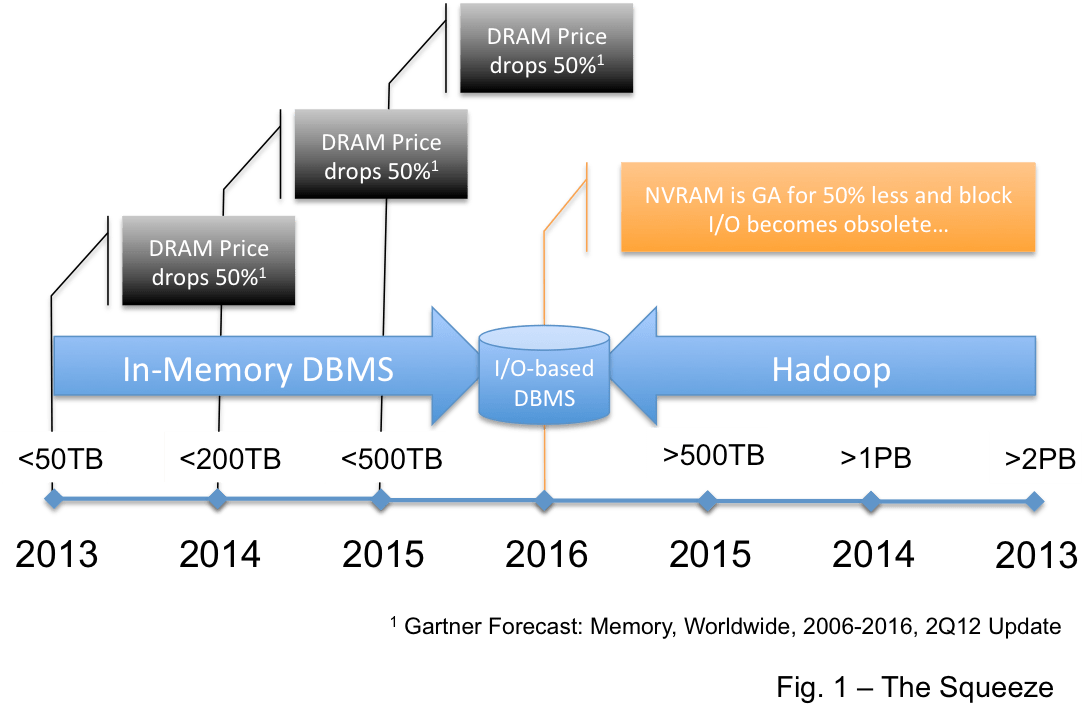
The SqueezeOne place is in the data warehouse market… This view says Hadoop replaces the DBMS for data warehouses. But the very mature BI/DW market requires a high level of operational integrity and Hadoop is not there yet… it is advancing rapidly as an enterprise platform and I believe it will get there… but it will be 3-4 years. This is the thinking I provided here that leads me to draw the picture in Figure 1.

It is not that I believe that Hadoop will consume the data warehouse market but I believe that very large EDW’s… those over 1PB… and maybe over 500TB will be compelled by the economics of “free” to move big warehouses to Hadoop. So Hadoop will likely move down into the EDW space from the top.

Another option suggests that Big Data will be a platform unto itself. In this view Hadoop will sit beside the existing BI/DW platform and feed that platform the results of queries that derive structure from unstructured data… and/or that aggregate Big Data into consumable chunks. This is where Hadoop sits today.

In data warehouse terms this positions Hadoop as a very large independent analytic data mart. Figure 2 depicts this. Note that an analytics data mart, and a Hadoop cluster, require far less in the way of operational infrastructure… they share very similar technical requirements.Hadoop Along Side

This leads me to the point of this post… if Hadoop becomes a very large analytic data mart then where will Greenplum and Netezza fit in 2-3 years? Both vendors are positioning themselves in the analytic space… Greenplum almost exclusively so. Both vendors offer integrated Hadoop products… Greenplum offers the Greenplum database and Hadoop in the same hardware cluster (see here for their latest announcement)… Netezza provides a Hadoop connector (here). But if you believe in Hadoop… as both vendors ardently do… where do their databases fit in the analytics space once Hadoop matures and fully supports SQL? In the next 3-4 years what will these RDBMSs offer in the big data analytics space that will be compelling enough to make the configuration in Figure 3 attractive?

Unified HadoopI know that today Hadoop cannot do all that either Netezza or Greenplum can do. I understand that Netezza has two positions in the market… as an analytic appliance and as a data mart appliance… so it may survive in the mart space. But the overlap of technical requirements between Hadoop and an analytic data mart… combined with the enormous human investment in Hadoop R&D, both in the core and in the eco-system… make me wonder about where “Big Data” analytic relational databases will fit?

Note that this is not a criticism of the Greenplum RDBMS. Greenplum is a very fine product, one of the best EDW platforms around. I’ll have more to say about it when I provide my 2 Cents… But if Figure 2 describes the end state for analytics in 2-3 years then where is the place for the Figure 3 architecture? If Figure 3 is the end state then I do not see where the line will be drawn between the analytic workload that requires Greenplum and that that will run on Hadoop? I barely can see it now… and I cannot see it at all in the near future.

Both EMC Greenplum and IBM seem to strongly believe in Hadoop… they must see the overlap in functionality and feel the market momentum of Hadoop. They must see, better than most, that Hadoop wins this battle.

Getting started with Hadoop… Enhance Your Data Warehouse Eco-system

Gartner thinks that the Big Data hype is going to die down a little for the lack of progress… (see here) Companies without web-scale, big, data are finding it hard to do anything commercially interesting… still CIO’s sense that Hadoop is going to become important. This post provides a suggestion that might help you to get started.

Hadoop goes here

In most data warehouse eco-systems there is an area, a staging place, where data lands after it is extracted from the source and before it is transformed. Sometimes the staging area and the ETL process are continuous and data flows through the ETL hardware system without seeming to land… but it usually is written somewhere.

The fact is that often enterprises only move data to their data warehouse that will be consumed by a user query. Often users want to see only lightly aggregated data in which case aggregation is part of the ETL process… the raw detail is lost. A great example of this comes from the telecommunications space. Call details may be aggregated into a call record… and often call records are sufficient to support a telco’s business processes.

But sometimes the detail is important. In this case the staging area needs to become a raw data warehouse… a place where piles of data may be stored inexpensively for a time… possibly for a long time.

This is where Hadoop comes in. Hadoop uses inexpensive hardware and very inexpensive software. It can become your staging area and your raw data warehouse with little effort. In subsequent phases, you can build up a library of the jobs that need to look at raw data. You might even start to build up a series of transformations and aggregations that might eventually replace your ETL system.

This is what Sears Holdings is up to (see here).

As I suggested in an earlier post, the economics of Hadoop make it the likely repository for big data. Using Hadoop as the staging area for your data warehouse data might provide a low risk way to get started with Hadoop… with an ROI… preparing your staff for other Hadoop things to come…


More on The Future of Hadoop and of Big Data DBMSs


First, you should look at Google’s Spanner paper here… this is the next-gen from Google and once it is embraced by the open source community it will put even more pressure on the big data DBMSs. Also have a look at YARN the next Map/Reduce… more pressure still…

Next… you can imagine that the conventional database folks will quibble a little with my analysis. Lets try to anticipate the push-back:

  • Hadoop will never be as fast as a commercial DBMS

Maybe not… but if it is close then a little more hardware will make up the difference… and “free” is hard to beat in price/performance.

  • SSD devices will make a conventional DBMS as fast as in-memory

I do not think so… disk controllers, the overhead of non-memory I/O, and an inability to fully optimize processing for in-memory will make a big difference. I said 50X to be conservative… but it could be 200X… and a 200X performance improvement reduces the memory required to process a query by 200X… so it adds up.

  • The Price of IMDB will always be prohibitive

Nope. The same memory that is in SSD’s will become available as primary memory soon and the price points for SSD-based and IMDB will converge.

  • IMDB won’t scale to 100TB

HANA is already there… others will follow.

  • Commercial customers will never give up their databases for open source

Economics means that you pay me now or you pay me later… companies will do what makes economic sense.

The original post on this is here