Hadoop and the EDW

Squeeze If You Feel Pain
Squeeze If You Feel Pain (Photo credit: Artotem)

Cloudera and Teradata have jointly published a nice paper here that presents an interesting perspective of how Hadoop and an EDW play together. Simply put, Hadoop becomes the staging area for “raw data streams” while the EDW stores data from “operational systems”. Hadoop then analyzes the raw data and shares the results with the EDW. Two early examples provided suggest:

  • Click stream data is analyzed to identify customer preferences that are then shared with the EDW. Note that the amount of data sent from Hadoop to the EDW would be fairly small in this case.
  • Detailed data is stored on Hadoop to build analytic models. The models are then transferred to the EDW to score sales activity data. Note that in this scenario the scored activity detail has to live in Hadoop to perform modeling… but it is unclear why it has to live in the EDW as well. I presume that scoring takes place on the EDW instead of in Hadoop for performance reasons… but maybe the data, the modeling, and the scoring should just take place in Hadoop?

The paper then positions Hadoop as an active archive. I like this idea very much. Hadoop can store archived data that is only accessed once a month or once a quarter or less often… and that data can be processed directly by Hadoop programs or shared with the EDW data using facilities such as Teradata’s SQL-H, or Greenplum‘s External Hadoop tables (not by HAWQ, though… see here), or by other federation engines connected to HANA, SQL Server, Oracle, etc.

But think about the implications on how much data has to stay in your EDW if you archive everything older than 90, or even 180, days to Hadoop. The EDW shrinks significantly and the TCO advantage to your Enterprise will be significant. This is very cool.

There is one item in the paper I disagree with, though… and another statement that I think has a very short shelf-life.

The paper suggests that indexes, materialized views, aggregate join indexes, and other tweaks are what differentiates an EDW. I believe that reliance on these structures make for a fragile EDW where only some queries can run fast. I like Teradata better when it just robustly scans fast and none of these redundant-data tuning artifacts are required (more here and here). Teradata was the original scan-fast DBMS… it is more than capable.

The paper also suggests that an EDW maintains value by including a sophisticated cost-based optimizer that uses data demographic statistics to identify an optimal query execution plan. I agree that Hadoop lacks this now… but there are several projects like Cloudera Impala that will eliminate this gap in the near term.

I believe that if you read between the lines you will see more evidence to support my belief (here) that Hadoop will squeeze the EDW vendors hard… and that the size of a squeezed EDW will then fit in an in-memory database.

MPP, IMDB and Moore’s Law

In the post here I listed the units of parallelism (UoP) applied by various products on a single node. Those findings are summarized in the table below.

Product

Version/HW

Cores per Node

UoP per Node

Notes

Teradata EDW 6700H

16

32

Uses hyper-threads.
Greenplum DCA UAP Edition

16

8

Recommends 1 Segment for each 2 cores. Maybe some multi-threading per query so it could be greater than 8 on the average… and could be 16 with hyper-threads… but not more than 32 for sure.
Exadata X3

12

12-24

Maybe only 12… cannot find if they use hyper-threads.
Netezza Striper

16

16

May use hyper-threads but limited by 16 FPGAs.
HANA Any Xeon E7-4800

40

80

Uses hyper-threads.

A UoP is defined as the maximum number of  instructions that can execute in parallel on a single node for a single query. Note that in the comments there was a lively debate where some readers wanted to count threads or processes or slices that were “active” but in a wait state. Since any program can start threads that wait I do not count these as UoP (later we might devise a new measure named units of waiting that would gauge the inefficiency in any given design by measuring the amount of waiting around required to keep the CPUs fed… maybe the measure would be valuable in measuring the inefficiency of the queue at your doctor’s office or at any government agency).

On some CPUs vendors such as Intel allow two threads to execute instructions in-parallel in a core. This is called hyper-threading and, if implemented, it allows for two UoP on a single core. Rather than constantly qualify the statements for the rest of this blog when I refer to cores I mean to imply hyper-threads.

The lively comments in the blog included some discussion of the sort of techniques used by vendors to try and keep the cores in the CPU on each node fed. It is these techniques that lead to more active I/O streams than cores and more threads than cores.

For several years now Intel and the other CPU manufacturers have been building ever more cores into their products. This has allowed them to continue the trend known as Moore’s Law. Multi-core is now a fact of life and even phones, tablets, and personal computers have multi-core chips.

But if you look at the table  you can see that the database products above, even the newly announced products from Teradata and Netezza, are using CPUs with relatively few cores. The high-end Intel processors have 40 cores and the databases, with the exception of HANA, use Intel products with at most 16 cores. Further, Intel will deliver Ivy Bridge processors to the market this year with 120 cores. These vendors know this… yet they have chosen to deliver appliances with the previous generation CPUs. You might ask why?

I believe that there is an architectural reason for this (also a marketing reason covered here).

It is very hard to keep 80 cores fed with data when you have to perform block I/O. It will be nearly impossible to keep the 240 cores coming with Ivy Bridge fed. One solution is to deploy more nodes in a shared-nothing configuration with fewer cores per node… but this will be expensive requiring more power, floorspace, administration, etc. This is the solution taken by most of the vendors above. Another solution is to solve the problem without I/O with an in-memory database (IMDB) architecture. This is the solution taken by SAP with HANA.

Intel, IBM, and the rest will continue to build out using the multi-core approach for the foreseeable future. IMDB products will be able to fully utilize this product. Other products will struggle to take full advantage as we can see already… they will adapt and adjust and do what they can… but ultimately IMDB will win, I think… because there is just no other way to keep up as Moore’s Law continues to drive technology… no other way to feed the CPU engines with data fast enough.

If I am right then you will see more IMDB offerings from more vendors, including from the major vendors in the near future (note that this does not include the announcements of “database in memory” from Oracle which is not by any measure an in-memory database).

This is the underlying reason why Donald Feinberg (and Timo Elliott) are right on here. Every organization will be running in-memory… and soon.

Indexes are not a good thing… A blog on TCO

In many of my posts I refer to the issues associated with building “extra” data structures to meet performance goals (see one of my first posts ever here). These extra structures are always a trade-off… slowing the performance of one function in order to speed up another. I thought that it might be helpful to be very clear about where I stand on this.

Indexes improve the performance of queries that address a small set of data. They also can improve join performance if your favorite optimizer can apply an index intersection to the execution plan for your queries. Indexes dramatically slow the performance of inserts, updates, and bulk data loads as they have to be maintained when data changes. You can mitigate the cost and update indexes in the background… the trade-off does not go away. Indexes are probably required for OLTP applications that pick out single rows.

Wouldn’t it be great if your favorite DBMS could resolve every query very fast without the overhead and operational effort associated with maintaining indexes? Certainly we should aspire to a read-optimized database, a data warehouse DBMS, that does not require indexes.

Vertica projections provide an optimized, materialized, view that improves the performance for a set of queries. The Vertica optimizer automatically selects the optimal projection. Vertica provides a very slick tool that builds projections based on the query set provided. I worded my post on Vertica a little vague… so let me be sure here to point out that  every Vertica query runs against a projection… so it is possible to have only one. In this case there is no additional overhead. Adding projections slows the data load process and increases the storage requirements. This is the trade-off.

Other databases offer materialized views. They make the same trade-off as above.

An OLAP cube is a physical structure that pre-aggregates data so that your query workload can avoid the aggregation. The best implementations of this express the cube as a materialized view so that queries can use the pre-aggregated data without explicitly pointing at a cube structure… the optimizer picks it for you. In addition the best implementations let you drill out of the cube to the detail records. These products have the update/delete/load issues of an index plus add an extra data latency issue as the data has to be aggregated on some interval… usually hours or days. Many products do not allow joins from a cube. You can see the trade-off. The Oracle Exalytics product materializes the aggregated cube on a separate server in-memory. This provides even more performance but adds the system and operational overhead of moving data across system boundaries.

Wouldn’t it be nice if you could query raw data and perform aggregation so fast that even against terabytes of data you could run any query with 3 second or less response without the overhead of building cubes?

You may build specialized table structures and pre-join, pre-aggregate, or pre-compute data to make a set of queries run fast. The cost of building and maintaining this sort of implementation versus just querying the base tables is the trade-off. Further, this approach is sort of a trap. You cannot build these structures for every query… if you did the business would conceive another critical query the next day that required work.

You can add indexes to the structures built using the technique above and provide very fast application-specific performance to a small set of queries. This is currently the favored approach when companies build iOS or Android apps as it provides the best possible performance… at a significant price.

Wouldn’t it be great if this was unnecessary… you could just scan so fast that mobile response service levels could be met from the base data regardless of the query.

You can deploy redundant data in operational data stores, data marts, cube servers, analytic data stores, and so on… with each specialized store providing performance for some limited set of queries at the cost of development and support ongoing. Each of these copies could deploy specialized database products that speed up that set of queries a little more. Again, this surround-the-EDW approach is a trap that leads to the proliferation of data marts and of database technologies.

Please do not take that last paragraph the wrong way… I believe that the worst possible approach is to blindly standardize on one or two database products. This trade-off makes life convenient for the IT department at the expense of performance and agility in the business. It is OK to have one or two favored products but IT must always serve the business to the best of their ability as a first priority… and sometime the new start-up has just the thing (remember that once Teradata was a start-up and DB2 on the mainframe was the IT standard…).

What I wish was that one or two products could solve all of the performance and functionality problems without the cost of building “extra” stuff… one product would be better that two. I like products that make the extra stuff “free”. Netezza does a nice job of making zone maps “free”, for example. Teradata and Greenplum provide the option of row store or column store for “free”. Vertica automatically build extra projections for “cheap”… and while there is a cost to the projection it at least does not require staff to tune it up. Oracle materialized views are “cheap”.

What I dislike are products that require DBAs to work harder and harder to apply all of the techniques above to meet performance SLAs. Each of these techniques trades off performance for development and operational expense.

As I have noted before… the performance SLAs for BI are about to become severe as companies try to support BI on mobile devices. The development and operational costs of tuning up; that is the TCO; will be significant unless better, faster, software infrastructure becomes available.

The TCO for a database that could eliminate these extra constructs and could eliminate the cost of developing and maintaining them; and could eliminate the architectural fragility these approaches imply… and replace this with a DBMS that holds base data which could satisfy all queries in seconds; delivering the business agility this implies… the TCO would be compelling.

I actually believe that the answer is available in the market today… this is no longer a pipe dream… more later…

Aster Data for a price…

Sharp-shinned Hawk, Accipiter striatus, chromo...
(Photo credit: Wikipedia)

If Greenplum HAWQ does not look promising (see my previous posts on HAWQ here and here) what are the prospects for Teradata Aster Data… which aspires to both replace and/or co-exist with Hadoop for a fee? Teradata+Hadoop maybe… but Teradata+Aster+Hadoop seems like one layer too many… as does Aster+Hadoop.

(OK, I removed the bad “HAWQing” pun in the title… no complaints from readers… it just seemed unfair… – Rob)

HAWQ and Pivotal HD – Is it Hadoop?

Green Plums
Green Plums (Photo credit: camera bag)

First, from a technical standpoint I like the Greenplum-on-HDFS HAWQ offering. It looks like the GP Team replaced XFS with HDFS and added some native support for several HDFS file types. I will say more on this soon.

But I would like to weigh-in on the question raised by HortonWorks here… is HAWQ Hadoop? And I have a question towards the end…

Let me propose an analogy: Hadoop is an eco-system of open source components much like LINUX is an eco-system of open source components. If you think the analogy apt, then HAWQ on HDFS  is not Hadoop any more than Microsoft Internet Explorer on LINUX is LINUX. Hive is open source and part of the Hadoop eco-system… as is Impala. Firefox is open source and part of the LINUX eco-system. HAWQ is not Hadoop.

The HortonWorks link points out that Greenplum is not engaged in the Hadoop eco-system as a contributor. They also quote Greenplum as saying that they have 300 developers working on Hadoop. Well… if HAWQ is part of Hadoop and HAWQ is the Greenplum database on HDFS then they have 300 developers on Hadoop. But if, as I suggested, HAWQ is not Hadoop then the number of Greenplum developers on Hadoop might be less. I bumped into a long-time Greenplum employee at Strata who told me that HAWQ was a skunkworks project with 4-5 developers max. This comes from a credible source… but it is still rumor-quality… so take it with a grain of salt.

The bottom line is that Greenplum has marketed very aggressively. They fuzz the definition of Hadoop to claim their commercial database offering running on Hadoop is therefore “Hadoop”. They fuzz the definition of developers working on Hadoop based on this first fuzz.

But does it matter? Greenplum will read and process data stored in HDFS faster than any other SQL-based engine. That is worth something.

But what is it worth? I’m fairly certain that the Greenplum databases will run faster off of Hadoop on XFS than in Hadoop… maybe significantly faster. So the reason for Greenplum on HDFS is faster SQL access to data in HDFS files.

This leads me to my question. I wonder… were the performance numbers quoted, showing a significant performance advantage over both HIVE and Impala, based on queries executed against the Greenplum proprietary table formats or against the same native HDFS file types read by HIVE? If they ran against Greenplum tables then I wonder what the real apples-to-apples comparison would show? Note that I am not being cynical here… I do not know how the tests were set up… only that Greenplum was fast. But if as I said: ” the reason for Greenplum on HDFS is faster SQL access to data in HDFS files” and the data was in Greenplum file structures accessible only by Greenplum then there is little reason left.

I also wonder if it matters because HIVE and Impala will improve their performance significantly over the next 12-24 months. The sheer amount of human R&D being expended here will allow these SQL engines to catch, or nearly catch, HAWQ in performance. If there is any gap left, the price and the community of open source offerings will defeat HAWQ in the market.

As I have suggested here… there is no apparent commercial opportunity competing against Hadoop at this point. I suggested here that Hadoop would eat Greenplum if they stuck to the analytics space and offered both products… effectively competing with themselves. This new strategy is not likely to work in the medium or long run. Greenplum is, indeed, all-in on Hadoop… but without a winning hand.

March 10: See here for the answers to my questions… – Rob

March 12: See here for a rethink on this subject… – Rob

My 2 Cents: Netezza 1Q2013

The TwinFin Surf Board
The TwinFin Surf Board (Photo credit: tvanhoosear)

Since my blogs tend to be in response to some stimulus they may not reflect a holistic view on any particular product. The “My 2 Cents” series will try to provide a broader view…

Please consider this as you read on…

Summary

Netezza put a new spin on data warehousing… they made it easy. The Netezza software includes a unique clustered index feature called a zone map that is powerful and easy to use. They also use a FPGA co-processor to augment the CPUs, offloading data compression and projection. When both of these innovations combine Netezza is hard to beat.

Zone maps are powerful when they can be used in a query plan… but the hardware is only good, not great, when zone maps are not in the plan. FPGAs provided a huge boost when Netezza first came on the scene… but as discussed here they do not provide the same boost today. In addition, FPGAs may limit the ability of a Netezza cluster to handle concurrent queries (see here and especially the comments).

The IBM acquisition has opened up a market of Blue shops to Netezza… so they are selling… and as a result Netezza is here to stay.

Where They Win

Of course, Netezza will win in all-Blue shops.

Netezza wins when there is a naturally sequenced field in each big table that is also used in the predicate for most queries. For example, if data is naturally in date/time sequence and every query has a date/time constraint then Netezza is hard to beat. This is the case most often for focussed data marts or single application databases… so look for Netezza for these sort of problems.

Netezza wins when there are a relatively small number of concurrent queries… and they can win when the queries are complex… as long as the zone map is in the plan.

Netezza can win when the POC is designed such that zone maps may be used in the POC… for example when the POC models only a single data load and the data is pre-sorted… even when the real application would fragment the data (for example… data will not naturally enter the warehouse sequentially by customer number… the same customer will be represented time and again… but if you load once only for a POC then you can sort by customer number and use it in the query predicates).

Note that I am not saying that Netezza is a poor performer when zone maps are not used… it is good… but they would never win a POC if no queries used the zone map.

Where They Lose

Guess what? Netezza loses when the zone maps cannot be used or can be used for only a small fraction of the query workload. Note again that the use of a zone map depends on two factors: the data has to be in sequence over all time, and the queries must use the columns mapped in the predicate. If data enters the system out of sequence then the zone map fragments and eventually loses the ability to speed up queries (a few random out of sequence rows are OK).

This constraint makes it hard for Netezza to service data warehouses where, by definition, lots of different user constituencies come at the data from lots of different directions… rather than always using the path grooved with a zone map.

Netezza was designed when only Sybase IQ had columnar oriented tables… today columnar is in nearly every DW database and this allowed the competition to cut deeply into Netezza’s competitive, zone-map enabled, edge. Teradata columns, Greenplum columns, or the natural column stores can win even when zone maps are on target.

Bottom line: do a POC…

In the Market

I spend most of my time in the general market for data warehousing. You won’t see me offer much of an opinion on HANA for BW, for example… even though there are ten thousand plus BW warehouses I just do not see them in the places I work.

Before Netezza was acquired by IBM they were everywhere… in nearly every POC. Now… not so much. To a very large extent they seem to have been directed into the Blue-only customer base (now that I think about it the same thing happened to the Ascential Data Stage suite of ETL products).

My Guess at the Future

As I noted in the reference above… I think that Netezza will eventually go away from the co-processor strategy.

There have been rumors for several years of design that allowed multiple zone maps. This would be very important… but loading out-of-sequence data, which is the necessary the result, could be very slow.

Netezza has lost some of its edge as other technologies added columnar capabilities to their technologies… and Netezza is surely looking at this… but their architecture which includes an execution engine on the server and on the FPGA makes this more complex than you might suspect. Zone maps and two-stage optimization (one in the server and once in the FPGA) is cool… but a tight coupling of the tricks makes for a difficult time extending and adding new features.

If I were the King of Netezza and I could not find a reasonable way to extend beyond the two tricks that got me here I would go with the flow… I would position Netezza as an extremely easy-to-deploy data mart appliance and hook it tightly (i.e. build in some integration) along-side DB2 and Hadoop… and I would cede the EDW space to DB2 and the Big Data space to Hadoop.

Next up… my 2 Cents on Greenplum

May 1, 2013: Here is an update, or maybe a summary, of my view on Netezza… – Rob

Will Hadoop Eat Greenplum and Netezza?

If I were the Register I would have titled this: Raging Stuffed Elephant To Devour Two Warehouse Vendors… I love the Register… if you do not read it have a look

This is a post is about the market implications of architecture…

Let us assume that Hadoop matures and finds a permanent place in the market. This is not certain with some folks expressing concern (here) and others boundless enthusiasm (here). So let’s assume… and consider where it might fit.

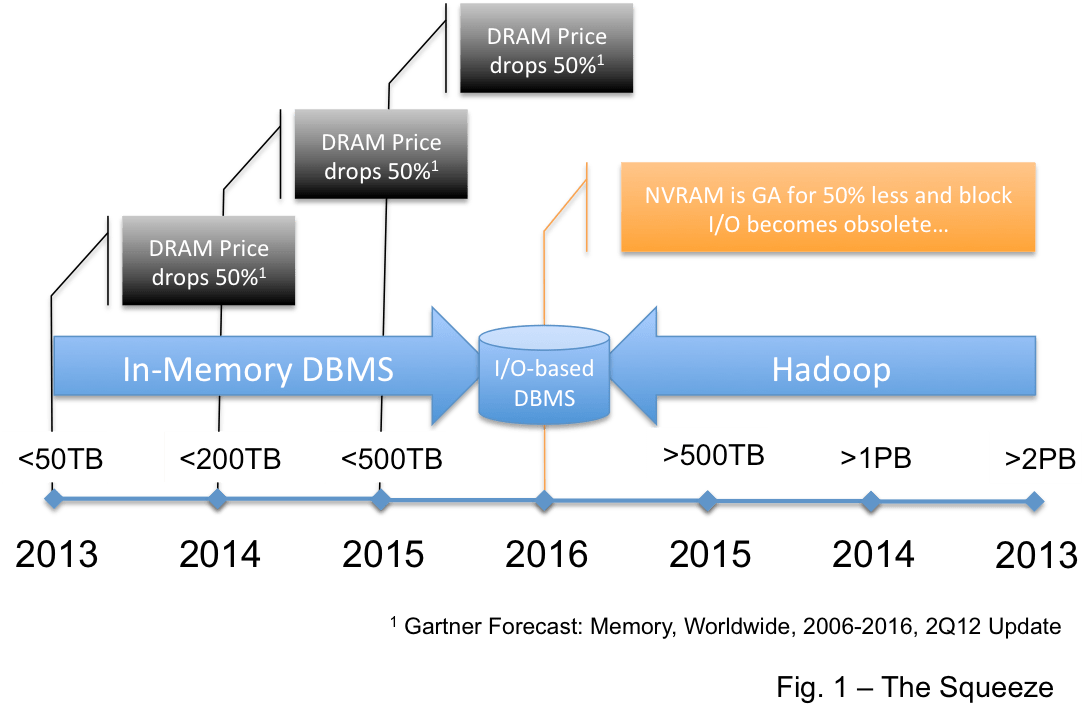
The SqueezeOne place is in the data warehouse market… This view says Hadoop replaces the DBMS for data warehouses. But the very mature BI/DW market requires a high level of operational integrity and Hadoop is not there yet… it is advancing rapidly as an enterprise platform and I believe it will get there… but it will be 3-4 years. This is the thinking I provided here that leads me to draw the picture in Figure 1.

It is not that I believe that Hadoop will consume the data warehouse market but I believe that very large EDW’s… those over 1PB… and maybe over 500TB will be compelled by the economics of “free” to move big warehouses to Hadoop. So Hadoop will likely move down into the EDW space from the top.

Another option suggests that Big Data will be a platform unto itself. In this view Hadoop will sit beside the existing BI/DW platform and feed that platform the results of queries that derive structure from unstructured data… and/or that aggregate Big Data into consumable chunks. This is where Hadoop sits today.

In data warehouse terms this positions Hadoop as a very large independent analytic data mart. Figure 2 depicts this. Note that an analytics data mart, and a Hadoop cluster, require far less in the way of operational infrastructure… they share very similar technical requirements.Hadoop Along Side

This leads me to the point of this post… if Hadoop becomes a very large analytic data mart then where will Greenplum and Netezza fit in 2-3 years? Both vendors are positioning themselves in the analytic space… Greenplum almost exclusively so. Both vendors offer integrated Hadoop products… Greenplum offers the Greenplum database and Hadoop in the same hardware cluster (see here for their latest announcement)… Netezza provides a Hadoop connector (here). But if you believe in Hadoop… as both vendors ardently do… where do their databases fit in the analytics space once Hadoop matures and fully supports SQL? In the next 3-4 years what will these RDBMSs offer in the big data analytics space that will be compelling enough to make the configuration in Figure 3 attractive?

Unified HadoopI know that today Hadoop cannot do all that either Netezza or Greenplum can do. I understand that Netezza has two positions in the market… as an analytic appliance and as a data mart appliance… so it may survive in the mart space. But the overlap of technical requirements between Hadoop and an analytic data mart… combined with the enormous human investment in Hadoop R&D, both in the core and in the eco-system… make me wonder about where “Big Data” analytic relational databases will fit?

Note that this is not a criticism of the Greenplum RDBMS. Greenplum is a very fine product, one of the best EDW platforms around. I’ll have more to say about it when I provide my 2 Cents… But if Figure 2 describes the end state for analytics in 2-3 years then where is the place for the Figure 3 architecture? If Figure 3 is the end state then I do not see where the line will be drawn between the analytic workload that requires Greenplum and that that will run on Hadoop? I barely can see it now… and I cannot see it at all in the near future.

Both EMC Greenplum and IBM seem to strongly believe in Hadoop… they must see the overlap in functionality and feel the market momentum of Hadoop. They must see, better than most, that Hadoop wins this battle.

My 2 Cents: Oracle Exadata 1Q2013

English: The logo of Oracle Corporation de:Bil...
(Photo credit: Wikipedia)

Since my blogs tend to be in response to some stimulus they may not reflect a holistic view on any particular product. The “My 2 Cents” series will try to provide a broader view…

To help pay the bills please consider this as you read on…

Summary

OK, I hate Oracle marketing (see here and here). They are happy to skirt the edge of the credible too often. But let’s be real… Exadata was a very smart move… even if it a flawed product. The flaws are painful but not fatal… and Oracle can now play in the data warehouse space in places they could not play before. I do not believe that Exadata is a strong competitor as you will see below… it will not win many “fair” POCs… but the fight will be more than close enough to make customers with existing Oracle warehouses pick Exadata once they consider the cost of migration. This is tough… it means that customers are locked in to a relatively weak alternative… and every Oracle customer (and every Teradata customer and every SQL Server customer and every DB2 customer) should consider the long-term costs of vendor lock-in. But each customer has to weigh this for themselves… and this evaluation of the cost of lock-in is about neither architecture nor marketing…

Where They Win

First and foremost Exadata wins when there is an existing data warehouse or data mart on Oracle that will have to be migrated. My recommendation to customers is that they think about this carefully before they engage other vendors. It is a waste of everybody’s time to consider alternatives when in the end no alternative has a chance… and it is a double waste to do a POC when even a big technical win by a competitor cannot win them the business.

Exadata can win technically when the data “working set” is small. This allows Exadata to keep the hot data in SSD and in memory and better still, in the RAC layer. This allows Oracle to win POCs where that can suggest a subset of the EDW data is all that is required.

Exadata can win when the queries required, or tested, contain highly selective predicates that can be pushed down in the first steps of the explain plan. Conversely, Exadata bonks when lots of data must be pulled to the RAC layer to perform a join step.

Where They Lose

Everyone who has an Exadata system or who is considering one should view the two videos here. The architectural issues are apparent… and you can then consider the impact for your workload.

As noted above… in an Exadata execution plan the early simple table scans and projection are executed in the storage layer… subsequent steps occur in the RAC layer… if lots of data has to be moved up then the cluster chokes.

There are times when the architectural limitations are just too large and a migration is required to meet the response time requirements for the business. This often happens when Exadata is to support a single application rather than a data warehouse workload… In other words, if the cost of migrating away from Oracle is small, either because the applications to be moved are small or because an automated tool is available to mitigate the cosy or because the migration costs are subsidized by another source, then Exadata can lose even when there is a migration required.

Exadata can be beat on price… unless you count the cost of migration.

In the Market

For the reasons above, Exadata wins for current Oracle customers. There was a honeymoon when Exadata was winning some greenfield deals against other competitors… but these are now more rare.

My Guess at the Future

I think that the basic architecture of Exadata is defensible… having a split configuration is , after all, not completely foreign. Teradata and Greenplum and others use master nodes split from data nodes… and this is where is I predict we’ll see Oracle go. Over time, more execution steps will move to the storage layer and out of the RAC layer and in the end, Exadata will look ever more like a shared-nothing implementation. This just has to be the architectural way forward for Exadata (but don’t expect LE to stand up anytime soon and admit that he was wrong all of these years about the value of a shared-nothing architecture).

Phil has alerted us that there will be some OLTP/BI enhancements coming (see the comments section here)… which stole away a prediction I would have made otherwise.

The bottlenecks pointed out by Kevin Closson (as above and more here) need to be addressed… but to some extent these issues are the result of hardware constraints… and the combination of better hardware configurations and the push-down of more execution steps can mitigate many of the issues.

It will be a while before the Exadata architecture evolves to a point where the product is more competitive… and from now to then I think the World will be as I described it above… Oracle zealots will pick Exadata either as a religious stance or to avoid the cost of a migration… others will mostly go elsewhere…

Coming next… my 2 Cents on Netezza…

My .2 Cents on HANA

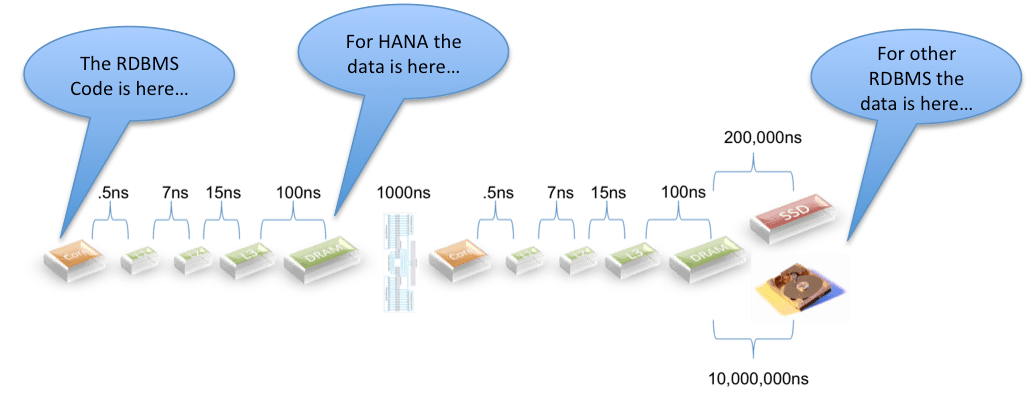
Out of respect for my employer let me repeat what I have said before regarding HANA… HANA provides far and away the best price/performance of any data warehouse… no question. HANA will win the performance portion of every POC just based on the facts detailed in this graphic:

Latency 3

Other products database code lives thousands to tens of thousands times further away from the data than in HANA. Based on this I honestly believe that HANA will come to dominate the market… And I’ll say more on this when I post my 2 cents on HANA…

But Teradata is the leader for good reason… and in the next posts providing my 2 cents I will find good things to say about several other  products…

This personal blog is not for marketing any particular product… it is about architecture…

To their credit my employer has given me no grief over the Teradata post… but I know that some folks are wincing over the idea that I would say something good about the competition… My apologies…

My 2 Cents: Teradata 1Q2013

Since my blogs tend to be in response to some stimulus they may not reflect a holistic view on any particular product. The “My 2 Cents” series will try to provide a broader view…

Teradata Storage Rack
Teradata Storage Rack (Photo credit: pchow98)

Summary

Despite my criticisms of some of their market positions (here, here, here, and here) Teradata provides the single best data warehouse platform in the market, hands-down. As an EDW, or data mart it is the best. It will be very competitive as an analytics mart and/or as an operational data store. It has a very complete eco-system of utilities and offers a robust set of Reliability, Availability, Serviceability, and Recoverability (RASR) features to make the eco-system solid. Performance is very good… Teradata should win more POCs than they lose… and they have become more competitive on price… so their price/performance is good if not great.

I recommend a POC for most customers in most cases… you can often save 20%-30% in a competitive situation.. but if you don’t have any special requirements… if you are building a standard BI/DW eco-system then Teradata would be the only vendor I would trust without a POC.

Where They Win

Now that they support columnar tables and columnar projection Teradata should win way more POCs than they lose (before columnar support they could lose to the column stores or to hybrids like Greenplum). The Teradata optimizer is very robust. It efficiently solves for a broad array of queries, and for a mixed workload that cuts across the data is many ways. This makes Teradata well-suited as the platform for an EDW.

Every RDBMS has a sweet spot where they win… so Teradata will not win every POC. But if you POC for an EDW and you prove with a full contingent of data, with queries that cut across the data in several ways, with a fair emulation of data loading, querying, loading , and querying… with a full workload… Teradata is tough to beat.

Where They Lose

The shared-nothing architecture is an imperfect fit on a single node… so other players can win smaller data warehouses that can fit on 1-2 nodes. In addition, they can be beat for very large configurations (1PB and above…) by Hadoop.

Teradata can be beat when the workload consists of very complex queries and/or where the problem to be solved requires fantastic response on a small number of CPU-intensive queries… this is a side-effect of spooling the intermediate results to a block device.

Teradata can be beat when data is trickled in at a high, continuous, rate.

Teradata can be beat when a query set goes through the data in a narrow way, using a single index or the equivalent, as might be the case for a data mart.

Teradata can be beat on price.

In the Market

For the reasons above, Teradata is the leader in the DW platform market. Recent competition from Exadata, Netezza, Greenplum, Vertica… and now HANA… has cut margins but not impacted business growth too much. Competitors have projected Teradata’s demise for 20 years now… but the product continues to set the standard.

As noted here, I believe that Hadoop will squeeze Teradata at the 1PB level and above…

My Guess at the Future

Teradata has three architectural challenges to address… and I suspect they will manage all three more-or-less.

First, the old architecture which was designed for very small DRAM configurations forces unnecessary I/O in violation of Gray and Putzolu’s Five Minute Rule (see here). This will be mitigated in the short-term by writing spool to SSD devices… and in the medium term by writing spool to NVRAM. If these mitigations are not sufficient then Teradata may have to consider re-engineering in a data flow scheme… but this will be tough.

Next, there are several advances in network technology coming in the next 2-3 years… and software defined networks will impact the space as well. ByNet may have served its purpose… providing Teradata with a significant edge for 20+ years… but Teradata may consider moving to an off-the-shelf network (see here).

Finally, a truly active data warehouse requires support for simultaneous OLTP and BI workloads… I would expect Teradata to build in the sort of hybrid OLTP/BI table capability now supported by both Vertica and HANA… and quasi-supported by Gemfire/Greenplum.

Teradata has some interesting business challenges as their margins shrink… and one of those challenges is that their expensive 3-person relationship/technical/industry sales team approach will face some pressure. But it is these sales teams that also provide Teradata an edge. They are the only databases vendor who can field team after team of veterans who understand both the technology and the vertical space.

If I were King of Teradata I might try to push downstream and build a configuration optimized for the low end. This would not be a high-margin hardware business but it would sell services and increase market share.